My 30 day app challenge...

About a year ago, my wife approached me with an idea.  It was the new year, 2014, and she was lamenting over the fact that she felt that we had not achieved the goals we had set out for ourselves back in 2013.  "Wouldn't it be nice" she said, "if there was an app that would let us set some goals, then allow us to track our progress towards those goals, and perhaps pop up a reminder from time to time to let us know we are on track...".

We searched around the app store, and while there were apps there that came close, none seemed to fit the bill.  "We should write that app!" she declared.  I nodded in agreement, but in the back of my mind, I know that my current 'real' work schedule didn't give me much spare time to even contemplate such a project.  We put together some vague specs for the app in a Google Doc, but it basically just sat there gathering dust.

Fast forward to the beginning of December, and I caught myself remembering that conversation from earlier in the year.  I realised that once again, we had fallen into the old habits of letting goals slip by in 2014.  After all, wasn't the idea to write a goal tracking app a goal in itself?

I had the usual end of year madness upon me, with clients wanting projects finished before the Christmas closure, but I looked at the vague specs my wife and I drew up earlier, and decided "Right!".  

I was going to do this.

Not only was I going to do this, but I was going to do it before the end of the year, so that the app would be ready to go out to the masses for the New Year 2015.  That gave me 30 days.  Factoring in the 2 week average approval period for the Apple App Store, it meant I would have to submit the final product for approval by mid December.  Time to get to work.

My first question was "Which platform?".  Both my wife and I are iPhone users, but my son has an Android phone and I wanted to cover both bases.  We decided iOS and Android would be the main platforms.  Windows, Blackberry etc. may have to come later.

Second question was "Which technology stack?".  I already had some familiarity with jQuery Mobile and PhoneGap etc., but I wanted a little more.  Then, I came upon a framework called Ionic, which is a mobile development framework based upon AngularJS.  When I first saw the demos for AngularJS, I went "Whoa!" in an excited way as I saw two way data binding etc. in action.  Then I delved deeper and looked at the code behind the scenes and went "Whoa!' in a kind of horrified, opening Pandora's box kind of way.

It certainly wasn't going to be an easy framework to get to grips with.  New methodologies and protocols such as Directives, Services, Factories, Promises etc. would be a completely new way of thinking about app development than what I was used to.

Nevertheless, I rolled my sleeves up and dived in head first.  Being a relatively new framework, Ionic questions and tips were hard to find on Google or StackOverflow.  Lots of things were trial and error.  Also, being on the 'bleeding edge' of current app development tools, there were a lot of incomplete things or things that would change literally overnight.  I would be in the middle of a late night coding session and would get a message saying that a new release was available.  Sometimes twice in the same evening!

One of the saving factors was the excellent community around Ionic, AngularJS and Cordova.  Plenty of REALLY smart people who are also generous with their time and knowledge.  I found some great blog posts which covered the areas I got stuck in, such as using SQLite databases on a mobile device via Cordova and Ionic.

Well, not 9 days later, we had an app ready to submit to the two app stores.  Not even I could believe it.  In reality, I had finished the first 1.0 version in about 6 days, but then when my wife and I tested the early version, we realised we wanted a few more things in there, so I went back to work to add more features.

Some 'simple' sounding features, like local notifications, proved to be a lot trickier than I imagined.  But once again, the Ionic forums came to the party and I found the answers there.  I even managed to improve on one of the answers a bit myself, and contributed back on the forums, so hopefully someone else in the same boat can get through the issue quickly.

Finally, on the evening of the 13th December, we submitted the app to both stores.  It is called BlissBank (which is the name my wife came up with) and hopefully will be approved by Apple by the 31st December.  There are still lots of things that I wanted to add to the app, and to clean up within it, but for now it appears to be stable, and will at least give us the chance to get a small user base together and get some feedback before we develop the next version.

It's been a long time since I went 'heads down' with such intensity on a project.  But being a personal project, and the brainchild of my own wife made it special and added a lot of incentive.  Kudos to my wife for giving me total support and allowing me as much time as I needed to go hard at this project too.  She took care of the other normal distractions around the house, like taking the kids out for long outings etc. to give me space and quiet.  Especially seeing as she was in the middle of launching her first art exhibition.

Now, I just have this one other idea for an app that would be useful for the New Year... Hmm... wonder if I can squeeze that in...


Cyclone Tracy - 40 years on

I have been thoroughly enjoying reading the stories on Facebook from my friends who lived through the destructive forces of Cyclone Tracy, 40 years ago.  My contribution isn't as poignant or direct as some of theirs, but it has a (kind of) twist ending.

During that time, I was about 8 years old, and we lived in a small town called Taiping, in my birth country of Malaysia.  At that stage as a kid, I had never travelled outside of the country.

The day after Christmas in 1974, my family was over at a neighbours house having drinks to celebrate the festivities.  The grown ups however, were distracted and talking about this devastating storm called a 'cyclone' that had destroyed an entire town called Darwin in Northern Australia.  As an impressionable kid, I was quite shaken by the serious, grave tones of the adults, and I left the party early to run back home to our own house.

We had a huge map of the world taped to the wall outside the bedroom my sisters and I shared, and I went and found a map pin and scoured the whole map for this place called "Darwin".  When I found it, I stuck the pin into the map over it, and vowed that I would NEVER, EVER go to that place in the world as long as I lived.

Well, just 4 years later, we were packing all our worldly belongings (and getting rid of most of it) to emigrate to Australia...to... a place called Darwin.  A place which I have happily called my home for three quarters of my life.

The Old Airport

For years in my town, it was fashionable to hate the 'old airport'.  You know, that sweltering tin shed left over from World War II.  Apparently there were still bullet holes in the steel girders from the Japanese Zero's that strafed it.  The building served as our domestic and international terminal in our little outback town for many decades.

I remember back before they built the new 'modern' airport, you would *always* hear people moan and complain about the old one.  "Why don't they upgrade it?" they would ask.  "It's a travesty, and embarrassment to us, an eyesore".

So in the 90's, they did build a new terminal.  A big concrete soulless, unaesthetic monstrosity that looks as plain and ugly as most other airports in the world.

You see, I hate the *new* airport.  But I never really hated the old one.  Here is why.

Because on that one day in December 1978, when we migrated to Australia, I remember stepping out of that QANTAS 747 on top of the mobile staircase (no aerobridges on the old terminal), and feeling the humid heat wrap around me, I blinked and took a mental picture of this place.  The picture I took in my mind is actually quite similar to the photo above.  We must have parked in about the same spot.

I was only about 12 years old, but I remember walking across the shimmering heat haze of the tarmac, through a glass door to the immigration area.

There, we lined up behind one of the customs desk, and waited patiently while a *huge* man in a tight fitting blue uniform scanned our passports and paperwork and stamped them.  He was actually the first Australian person I had seen here since we arrived from Malaysia, and I was impressed and intimidated by his sheer size.

I remember his intent look as he processed our paperwork, and sweat rolling down his face as the overhead fans did little to alleviate the heat in that hot section of the tin shed.

Far from being scary, he actually turned out to be really kind as he looked at us, smiled and welcomed us to our new home.

After we passed through the immigration, my two sisters, my mother and I went to the public waiting area.  My dad had already arrived in Australia before us to set things up, and was going to pick us up soon.

My older sister and I were feeling rather parched in this heat, so we decided to buy a cold drink.  We carefully counted out the small amount of Australian money we had, and checked the price list above the only refreshment stall in the centre of the airport, and decided that we had enough money for two cups of orange juice.

As we approached the cheery young girl behind the counter, she smiled at us and said "Just a minute, I have to refill the OJ machine".  I watched her as she pulled the spouts out on several tetra pack juice cartons to fill the machine.

I was filled with wonder - I had NEVER before seen juice packs with the spouts that you could split and pull with one hand.  All the ones we had in our 'old' country had to be cut with scissors.  I thought this was the precursor to MANY wonders that we would get to see in this new land.

Then, my mother reminded us that we needed to get our luggage.  I looked around for the carousel, but could only see signs pointing to a fenced off area next to the car park.  We went there but it was empty.

Then I noticed that there was a tractor with several baggage trailers still near our plane, which was busy disgorging the contents of its hold onto the trailers.

Shortly after that, the tractor just drove into the fenced baggage area and the tractor driver parked and opened the fence gate so that we could all approach the trailers and pick our luggage off them.

Yes it was rustic, but it was also magical and quaint at the same time.  I had this combined feeling of dread and excitement at our new lives that were about to be rebooted here.

The old airport now stands silent, empty and abandoned, but it will always be a major milestone in my life, and for that reason, I could never bring myself to hate it.

Learning the Shakuhachi

Many years ago, I had read the graphic novel "Usagi Yojimbo" by Stan Sakai.  It is a story about an anthropomorphic rabbit called Miyamoto Usagi and his travels and adventures around ancient Japan.

In one of those adventures, Usagi comes across a Komuso monk ("monk of emptiness") who played the Shakuhachi flute.  From that moment on, I was fascinated with this instrument.  In the story, the monk explains to Usagi that the flute was a way of meditating, and trying to copy the music of nature.

I had been thinking of getting one of these, but when I researched online, I noticed that the best flutemakers around charged approximately $2000 up to $5000 for a hand made flute.  But a couple of weeks ago, I was doing another search and I came across Perry Yung's website, where he explains more about the flutes, and also where he sells a range of flutes from beginner 'Earth' models for around $150 right up to the high end ones, that take a year to make and are worth $2000+.

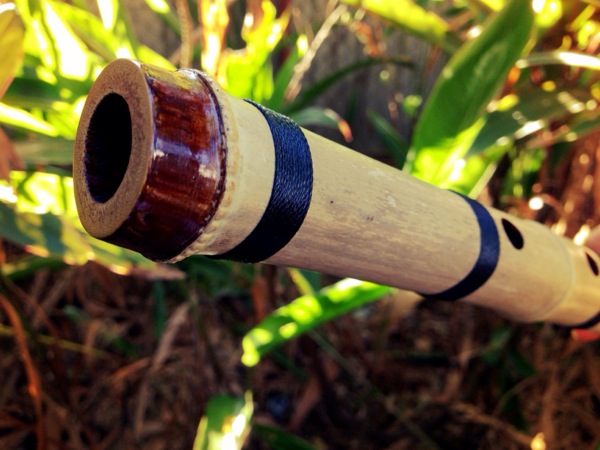
I decided to order an Earth model from Perry, and he was great during the initial contact and enquiry.  He even made a short demo video for me of the Earth model flute that he had.  I decided to go ahead, and Perry finished binding the flute for me, as well as applying a coat of traditional lacquer to protect it.

It arrived earlier this week, and I was as excited as a kid at Christmas.

iphone-20140606164516-0.jpg
iphone-20140606164516-1.jpg
iphone-20140606164516-2.jpg
iphone-20140606164516-7.jpg

This is a 1.8 flute, and tuned to 'C'.  The flute plays the pentatonic scale, and by breath control, you can achieve two octaves.

One thing I've discovered, is that it is not easy to play the Shakuhachi.  There is a lot of work to do with positioning the flute, as well as my breathing, in order to get the proper sound.  After about 10 minutes of playing, I am quite light headed and giddy from the breathing, which I think is a GOOD thing, because I've noticed recently that my sedentary work style has lead to very shallow breathing and a general level of unfitness.

Perry included a great CD and booklet with the flute, which will hopefully help me along my journey.  This is an instrument best taught by a teacher, but alas there are none in Darwin, so I will have to soldier through with Youtube videos and the book/CD set.